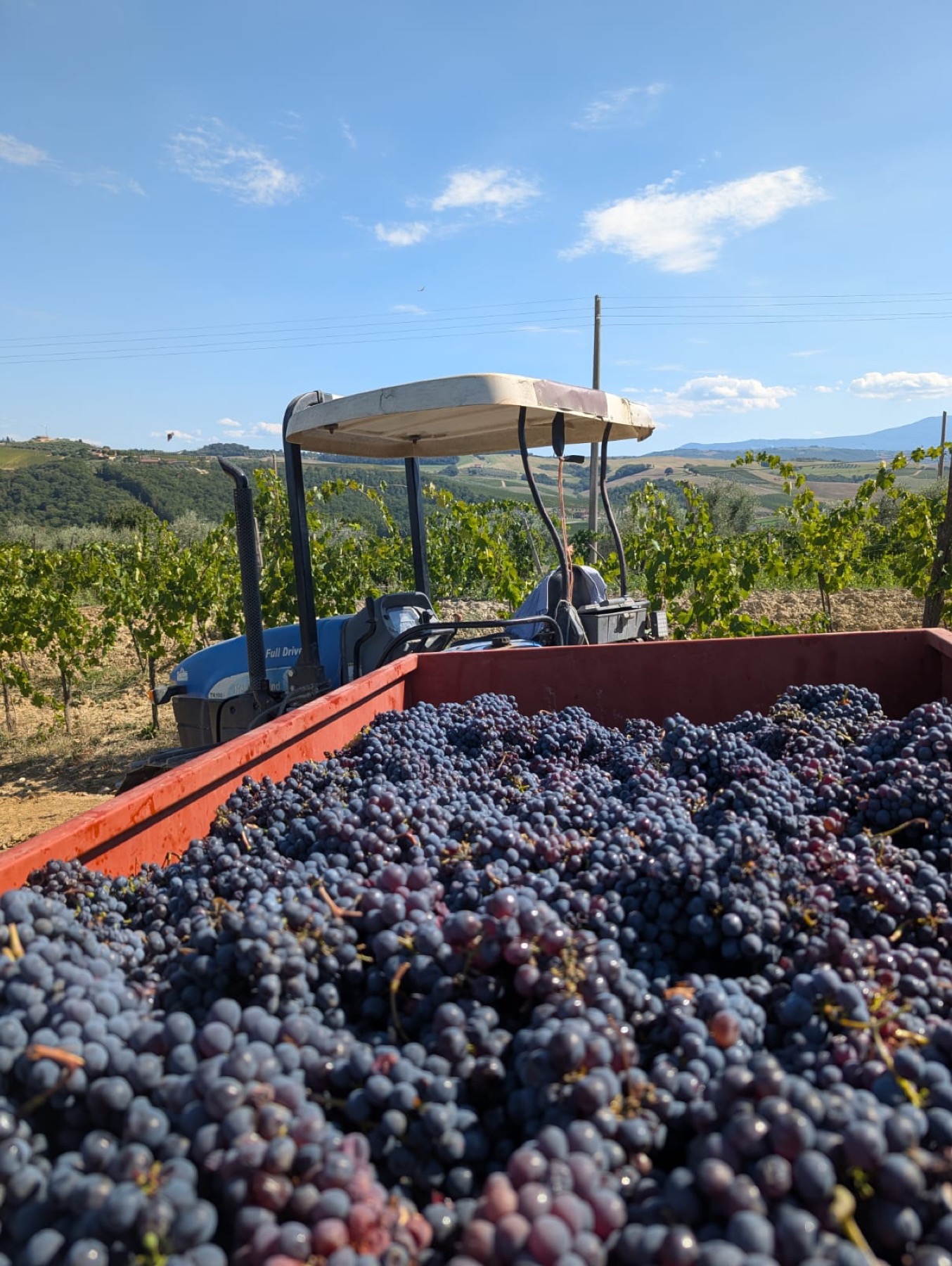
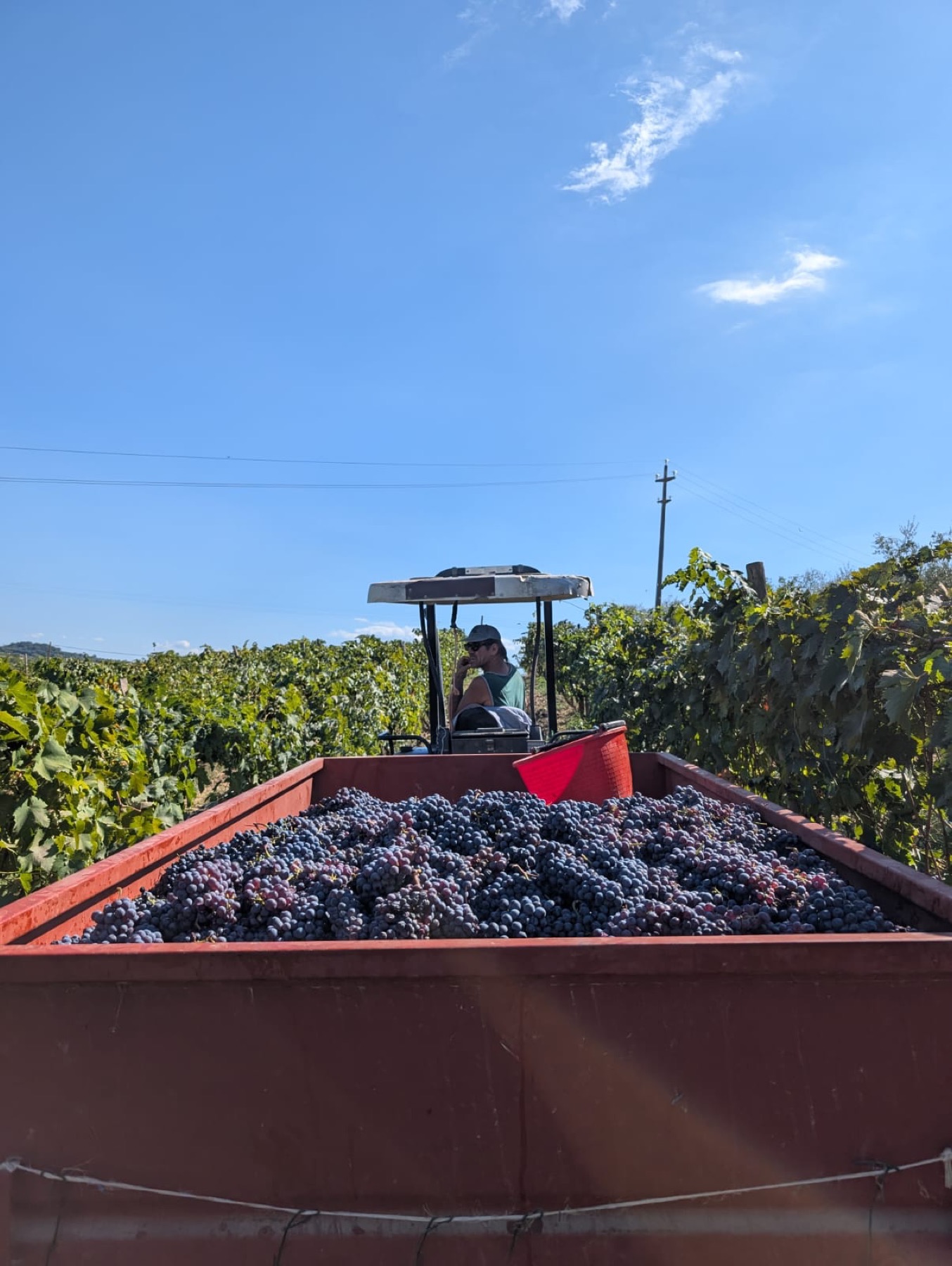
We picked the grapes today. The trailer left full for the winery next door — and this is the time of year when the valley stops being a postcard and goes back to being what it is: a place where people work.
Val d’Orcia in September looks nothing like the summer photographs. The wheat was cut months ago, the hills have turned brown again, and there are tractors moving between the rows. It’s harvest week, and it doesn’t last: you decide day by day, looking at the fruit and at the forecast, then you go, and in a few days it’s over.
This confuses a lot of people who write to us. Our farm is at San Giovanni d’Asso, which since 2017 has been part of the municipality of Montalcino: on paper we share an address with the most famous wine in Tuscany. But the Brunello denomination has its own rulebook and its own mapped territory, and that map does not follow the municipal boundary.
We’re on the other side of it, where Montalcino fades into the Crete Senesi: clay, eroded ridges, lone oak trees. This is truffle and ancient-grain country rather than collector’s-wine country — and that suits us. There are vines, as there are on almost every farm around here, but they sit alongside the vegetable garden, the olive grove, the spelt fields and the animals.
Making wine isn’t like making oil. You need tanks, temperature control, a winemaker following the fermentation day by day, space to age it, bottles, labels, paperwork. For a farm our size — one that already has the garden, the grains, the animals, the school groups and guests to look after — opening a wine department would mean doing it badly.
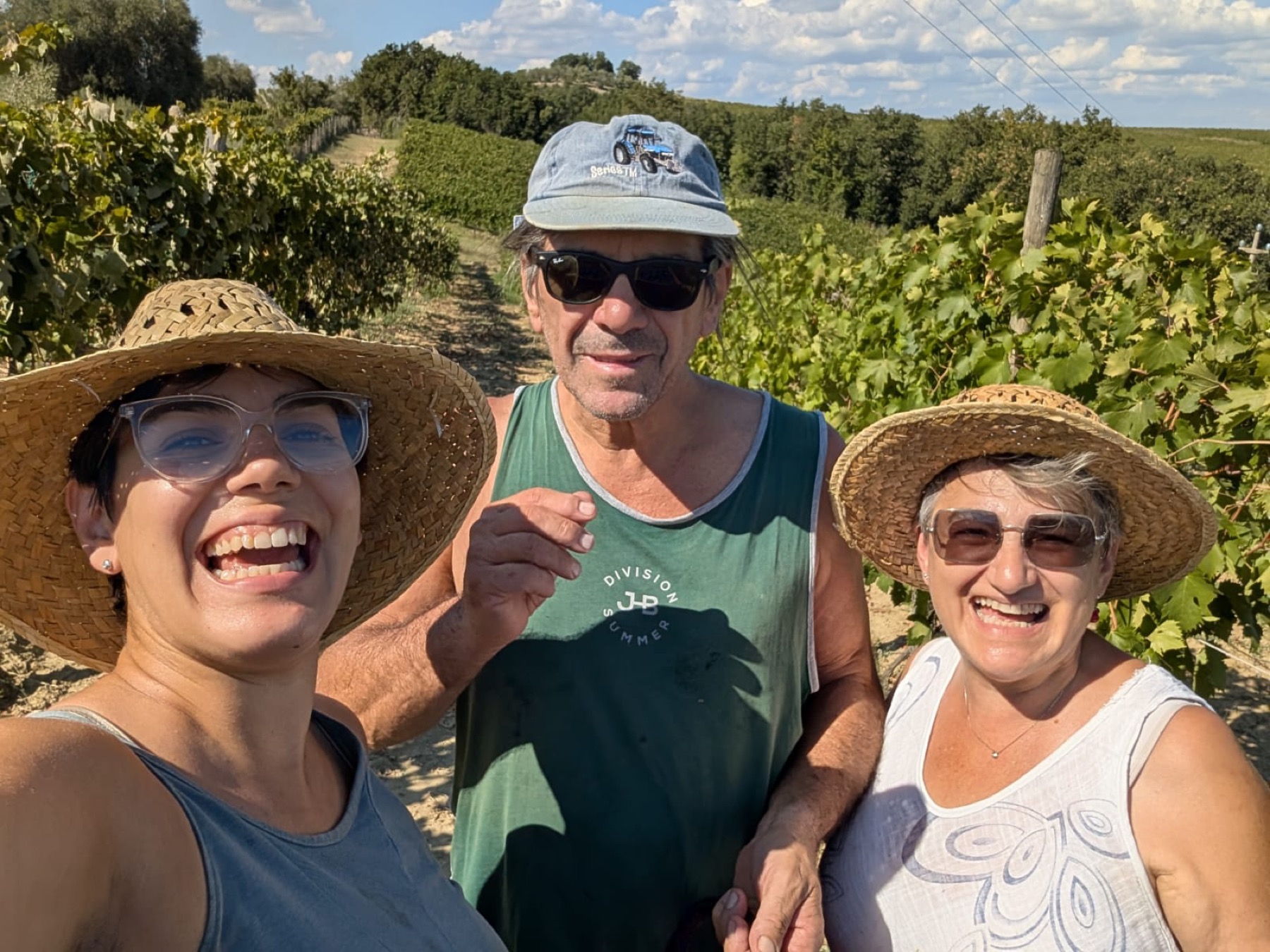
Harvest day is still ours, and one of those days when the whole family is out in the rows. Then we do what country people have always done: we take the grapes to someone who knows how to make wine. In our case that’s Atrivm, a family farm at Podere Camera, a few kilometres away and also within the municipality of Montalcino. They are much like us, except that they have the cellar and they follow the winemaking from start to finish.
From that point on the grapes are no longer ours: they become their wine, under their label. You won’t find a Biofattoria L’Upupa wine, because there isn’t one — and we’d rather say so plainly than let it be assumed. What is true, and what we like telling people, is that some of what gets drunk around here starts in our rows.
There’s a reason we suggest autumn to anyone who asks when to come. In summer the countryside is still and the heat is heavy; from mid-September onwards things happen one after another: first the grape harvest, then the white truffle season at San Giovanni d’Asso, and in November the olive picking and pressing — with new oil, which is a different thing entirely from oil six months later.
It’s also when the restaurant opens for weekend lunches again and farm visits become comfortable, without the sun on your back. The gravel roads are dry and the cyclists are out, the light goes low early in the afternoon, and the villages of the valley — Montalcino, Pienza, Bagno Vignoni — can be visited without the queues.
If you’re here in these weeks and want to see a real cellar, just ask us: there are several within a few minutes’ drive that open their doors for a tasting. With us you sleep in the farmhouse apartment or the rooms, and dine by reservation, on whatever the fields are giving at this point in the year.